


Enterprise AI Engineering
AI Agent Readiness Assessment: The 30-Point Production Checklist
Determine whether your workflow, data, integrations, permissions, evaluations and operating model are ready for a production AI agent.
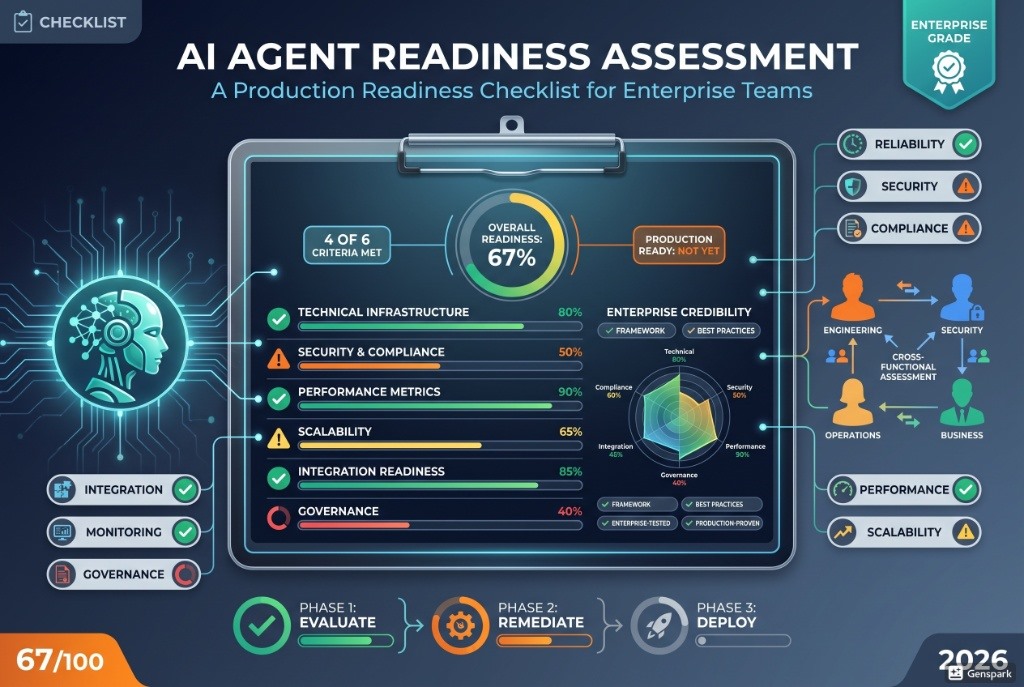
AI agents can retrieve information, choose tools, make decisions, update records, communicate with customers and initiate business actions. That makes them more useful than conventional chatbots, but it also makes premature deployment considerably more expensive.
A chatbot that produces an inaccurate answer creates a quality problem. An AI agent with excessive permissions can create a security incident, expose confidential data, modify production records or execute a transaction nobody intended.
What is an AI agent readiness assessment?
An AI agent readiness assessment is a structured evaluation performed before an autonomous or semi-autonomous system receives meaningful access to company data, software, customers or operational workflows. It determines whether the use case should proceed, which controls are missing and what evidence must exist before production deployment.
A responsible assessment does not promise that every risk can be eliminated. It determines whether the organization can control, observe, interrupt and recover the agent when normal assumptions fail.
Readiness visualization
Six production-readiness dimensions
The use case has a measurable outcome, a documented workflow, an accountable owner and a justified level of autonomy.
Authoritative sources, sensitive-data classifications, retrieval permissions, lineage and deletion procedures are verified.
Every connected tool has a narrow purpose, safe failure behavior, scoped credentials and a realistic test environment.
The agent has a unique identity, least-privilege access, action-time authorization and controls outside the language model.
Representative test cases, business-risk metrics, adversarial tests and deployment thresholds are defined.
Production activity is observable and the organization can escalate, revoke, contain, recover and retire the agent.
Why successful AI prototypes fail in production
Prototypes operate in artificially simple environments. They often use a small document collection, broad developer credentials, cooperative testers and workflows with no meaningful transaction or compliance risk. Production removes those protections.
Real users provide incomplete instructions. Documents conflict. Permissions change. APIs fail. Sensitive data appears in unexpected locations. Retrieved content may contain malicious instructions. Models can choose the wrong tool or construct unsafe arguments.
The relevant question is therefore not merely whether the agent can complete its happy path. The question is whether the organization can govern the agent under ambiguity, failure and adversarial conditions.
The complete framework
The 30-point AI agent readiness checklist
Business and workflow readiness
1. Define a measurable business outcome
“Use AI” is not an outcome. Define the operational result the agent must improve, its baseline, target, measurement period and accountable owner. Examples include reducing resolution time, accelerating document review, improving qualified appointment rates or reducing a specific manual workload.
2. Document the complete workflow
Record trigger conditions, inputs, decision points, systems, business rules, outputs, exceptions and escalation paths. Interview experienced operators to uncover institutional knowledge and shadow processes that do not appear in formal documentation.
3. Confirm the workflow is stable
Automating a broken or constantly changing process usually amplifies its defects. Simplify unnecessary handoffs, resolve conflicting rules and determine whether the workflow is sufficiently repeatable before adding autonomous behavior.
4. Choose the minimum required autonomy
Decide whether the agent should inform, recommend, prepare an action, execute reversible actions within limits or operate autonomously. Production autonomy should be earned through evidence rather than granted because a demonstration was impressive.
5. Assign an accountable owner
A named business owner must approve the purpose, connected systems, acceptable behavior, success metrics, escalation policy and material changes. Technical ownership alone is insufficient when an agent influences an operational decision.
Data and retrieval readiness
6. Identify authoritative sources
Document the owner, purpose, freshness, sensitivity and reliability of every source. Define which source wins when policies, records or documents conflict. An agent that retrieves from multiple repositories without an authority hierarchy will eventually produce confident contradictions.
7. Measure data quality
Evaluate completeness, accuracy, freshness, duplication, contradictions, missing metadata and orphaned content against the intended use case. Data adequate for internal search may be unacceptable for financial, clinical or customer-facing decisions.
8. Classify sensitive information
Determine whether the agent can encounter personal information, health records, financial information, legal communications, credentials, source code, contracts or trade secrets. Classification must affect ingestion, retrieval, logging, retention and model selection.
9. Preserve permissions during retrieval
Retrieval must consider user identity, agent identity, tenant, group membership, resource ownership, classification and purpose. Filtering after unauthorized material has entered the model context can be too late.
10. Maintain embedding lineage and deletion
Every embedding should be traceable to its source. Establish procedures for re-indexing changed information, deleting revoked content, responding to access changes and proving removal across replicas and caches.
Integration and tool readiness
11. Inventory every connected tool
List every API, database, CRM, messaging platform, file repository, browser, payment service and administrative system the agent can access. Document allowed operations, authentication, expected arguments, rate limits and prohibited actions.
12. Design narrow business tools
Prefer a specific operation such as getOrderStatus(orderId) over unrestricted database access. Narrow tools reduce ambiguity, simplify authorization and limit the blast radius of model or prompt failures.
13. Separate read and write capabilities
Read, update, delete, publish, transfer and permission-changing operations should not share identical controls. High-impact or irreversible actions require stronger authorization and often explicit human approval.
14. Handle integration failure safely
Define timeout behavior, retry limits, idempotency, duplicate prevention, rollback and partial-failure handling. A technical failure must never be interpreted as business approval or permission to continue.
15. Use a realistic test environment
Test with realistic permission boundaries, data distributions, API failures, ambiguous inputs, tenant separation and expected volume. A sandbox where every system returns perfect responses creates false confidence.
Identity, authorization and security
16. Give the agent a unique identity
Do not hide production activity behind a developer account or shared service credential. A unique non-human identity enables attribution, agent-specific policy, revocation, investigation and lifecycle management.
17. Apply least privilege
Grant only the systems, records, tools and operations necessary for the current task. Development credentials are often dangerously broad and should never be carried unchanged into production.
18. Use short-lived credentials
Prefer task-scoped, short-lived and centrally revocable tokens. Rotate credentials, isolate secrets and never place credentials inside prompts, retrieved documents, browser storage or model-visible context.
19. Authorize every important action
Authentication proves identity; authorization determines whether that identity may perform a specific action on a specific resource now. Evaluate the agent, delegating user, action, target, sensitivity, transaction value and approval status at execution time.
20. Treat external content as untrusted
Documents, websites, emails and tool responses can contain malicious instructions. Keep security enforcement outside the model, validate tool arguments, restrict tools, preserve provenance and require confirmation for high-impact actions.
Evaluation and quality readiness
21. Build a representative evaluation set
Include routine requests, ambiguous instructions, incomplete context, conflicting sources, restricted requests, adversarial prompts, tool failures and historical incidents. Define expected behavior before running the tests.
22. Measure business-risk outcomes
Track task completion, tool selection, argument correctness, retrieval precision, citation validity, escalation accuracy, permission violations, cost, latency and customer outcomes. A single average accuracy score can conceal unacceptable failure categories.
23. Test security boundaries
Attempt cross-tenant retrieval, unauthorized tool use, secret extraction, approval bypass, duplicate transactions and continued action after revocation. Repeat these tests whenever models, prompts, tools or retrieval logic change.
24. Version models and prompts
Store model versions, prompts, tool schemas, evaluation results, approvals and deployment history. A model or prompt update can change refusal behavior, tool selection, structured output and operational risk.
25. Set acceptance thresholds before launch
Define non-negotiable deployment thresholds such as zero cross-tenant retrieval, no unauthorized actions, minimum citation correctness, successful recovery tests and maximum cost or latency. Do not redefine success after seeing the result.
Operations, governance and recovery
26. Make production behavior observable
Capture agent identity, delegating identity, retrieved sources, tool calls, authorization decisions, approvals, errors, latency, cost and final outcome. Redact sensitive data where required without destroying audit value.
27. Implement an operational kill switch
Operators must be able to revoke credentials, disable tools, stop queued actions and suspend the workflow quickly. Test the process; a kill switch that exists only in documentation is not a reliable control.
28. Define human escalation
Escalate low-confidence, high-value, sensitive, exceptional or legally significant cases. Transfer enough context for the reviewer to continue without reconstructing the entire interaction.
29. Rehearse incidents and rollback
Run technical and tabletop exercises. Verify that the team can identify affected actions, reverse incorrect writes, restore prior versions, determine possible exposure and preserve evidence for customers, leadership or auditors.
30. Govern the complete lifecycle
Register, classify, approve, monitor, review and eventually retire every production agent. Remove credentials, tools, data copies and embeddings during decommissioning so abandoned agents do not remain active risks.
How to score your readiness
Missing
No reliable control or evidence exists.
Partial
The control exists informally or covers only part of the workflow.
Verified
The control is documented, implemented, tested and supported by evidence.
Critical controls override the numerical score
A high total cannot compensate for a missing control that exposes the organization to unacceptable impact. Do not grant meaningful production autonomy when ownership, unique identity, least privilege, tenant isolation, action-time authorization, auditability, escalation, revocation or containment remains unresolved.
What a professional assessment should deliver
A professional review should produce usable engineering artifacts, not only a presentation. Deliverables should include a workflow map, data inventory, tool inventory, permission model, threat analysis, evaluation plan, observability requirements, escalation design, remediation roadmap and defensible go, conditional-go or no-go recommendation.
The result should tell leadership what can proceed, what must change, who owns each change and which evidence will demonstrate that the risk has been addressed.
When to use an independent readiness assessment
Independent assessment is valuable when the same team built and approved the prototype, the agent handles regulated data, multiple tenants are involved, the workflow performs transactions, security architecture is unresolved or leadership needs a defensible production decision.
Frequently asked questions
What is an AI agent readiness assessment?
It is a structured review of the business workflow, data, integrations, identity, authorization, evaluation, monitoring and recovery controls required before an AI agent receives production access.
How is AI agent readiness different from general AI readiness?
General AI readiness usually examines strategy, data and organizational adoption. Agent readiness also evaluates autonomy, tool use, action-level authorization, production failure, containment and rollback.
Does an AI agent need its own identity?
Production agents should generally use unique identities so their permissions, credentials, actions, owners and lifecycle can be independently governed and audited.
How long does a professional readiness assessment take?
A focused assessment for one defined workflow commonly takes one to three weeks depending on integration complexity, stakeholder availability, documentation quality and security requirements.
What should block an AI agent from production?
Missing ownership, broad shared credentials, unresolved tenant isolation, absent action authorization, no representative evaluation, inadequate auditability or an untested containment process should block meaningful autonomy.
Move from prototype confidence to production evidence
SCAIROS performs fixed-scope AI Agent Readiness Audits that map workflows, architecture, data exposure, permissions, failure modes and operational controls before deployment.