


AI Inference Cost Audit: What It Finds, What It Costs and When It Pays Off
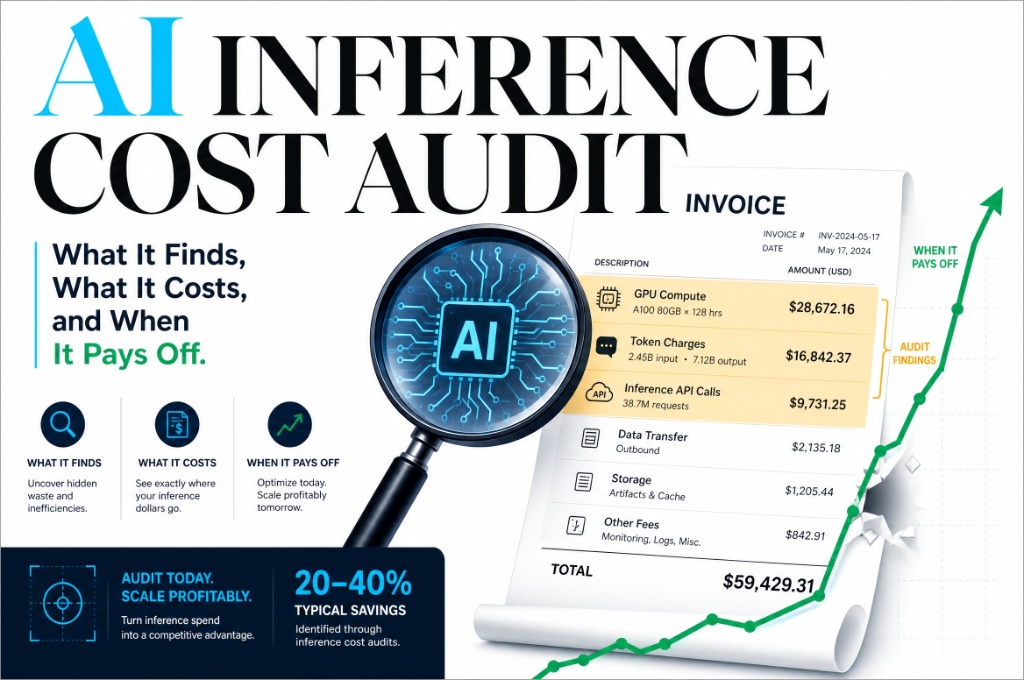
An AI inference cost audit analyzes production usage to determine which workflows drive spend, whether each request uses an appropriate model and where routing, caching, batching, context reduction or retry controls can lower costs without crossing the required quality threshold.
Definition
What an AI inference cost audit actually is
An AI inference cost audit is a structured analysis of the money consumed when production applications call language models, embedding models, rerankers and related AI services. Its purpose is not merely to find the cheapest model. It establishes which work the system performs, what capability that work requires and whether the resulting business value justifies the compute consumed.
A provider invoice can show that a company spent a certain amount on a particular model. It usually cannot explain that a support summarization workflow uses a frontier model, that an agent retries malformed tool calls four times, or that a repeated 20,000-token instruction prefix invalidates the expected economics of every customer interaction.
The audit connects technical usage to operational units: feature, workflow, customer, tenant, task and successful outcome. That distinction matters because a cheap model call is not necessarily economical. Ten inexpensive failed calls may cost more than one premium call that resolves the task.
The principal metric is not cost per token.
It is cost per accepted, resolved or completed business outcome, measured against the quality and risk requirements of that outcome.
Production economics
Why inference bills grow even while model prices fall
Falling token prices do not guarantee a falling AI bill. Production consumption can grow faster than unit prices decline. More users generate more requests, while agentic systems can multiply each user action into planning, retrieval, tool-selection, validation, retry and summarization calls.
The most expensive model is not always the largest source of waste. Cost frequently accumulates through repeated context, unnecessarily long output, excess retrieval, retries after predictable validation failures and fallback policies that pay multiple providers for one outcome.
One model for every task
Routine classification and formatting inherit frontier-model pricing without evidence that the capability is necessary.
Repeated context
System instructions, tool schemas and retrieved content are sent repeatedly without effective cache structure.
Agent-call multiplication
One customer request creates planning, retrieval, execution, validation and summarization calls.
Retries and fallbacks
Timeouts, malformed outputs and failed tool calls silently repeat full-cost requests.
Audit objectives
Seven questions a defensible audit must answer
- 1
Which workflows, agents and customers produce the largest share of inference spend?
- 2
What does one accepted, resolved or completed business outcome actually cost?
- 3
Which requests require premium-model capability and which only inherit it by default?
- 4
Which prompt prefixes, tool definitions and retrieved passages are repeatedly processed?
- 5
Which workloads can tolerate asynchronous batching instead of real-time execution?
- 6
How much spend is created by retries, timeouts, agent loops and fallback duplication?
- 7
What quality, latency, security and consequence thresholds must remain protected?
If an assessment cannot answer these questions with measurable evidence, it is a collection of optimization ideas rather than an audit.
Evidence
What data should be included?
Initial analysis rarely requires unrestricted access to production prompts. A metadata-first export can establish the cost baseline, distribution and operational anomalies while reducing the exposure of customer and company information.
Do not place secrets into an audit export
Exclude API keys, authentication tokens, private keys, customer records, unrestricted system prompts and retrieved confidential documents. If content-level evaluation is necessary, redaction, access, retention and deletion rules should be established before transfer.
Workload analysis
Classify requests by complexity and consequence
Prompt length alone is not a reliable complexity measure. A long document-classification request may require limited reasoning, while a short instruction to issue a refund has significant financial consequence. A production policy should account for both.
Routine
Formatting, extraction, tagging, sentiment classification, deterministic transformation and templated responses.
Standard
Grounded questions, ordinary summarization, drafting, customer support and constrained tool selection.
Complex
Multi-document synthesis, ambiguous reasoning, difficult planning, evaluation and complex tool sequencing.
High-consequence
Payments, refunds, legal or financial outputs, destructive actions, sensitive communications and regulated decisions.
High consequence should override low apparent complexity. A request can be inexpensive to understand but expensive to get wrong.
SCAIROS methodology
Value of Compute™
Value of Compute matches the cost and capability of an AI request to the value, quality and risk of the work being performed. It treats optimization as an ordered financial model—not a list of independent percentages.
This sequence prevents a common error: claiming routing, caching and batching savings against the same original dollar. Once one optimization reduces the baseline, the next applies only to the eligible spend that remains.
Worked example
How an audit models opportunity without promising it
Monthly requests
500,000
Current monthly spend
$18,000
Routine requests
55%
Standard requests
30%
Complex and consequential
15%
Retry and fallback overhead
8%
Repeated-context estimate
35%
Batch-eligible workload
20%
The baseline cost is 3.6 cents per request. That number is useful but incomplete because it does not show how many requests fail, how many calls belong to one user outcome or which workflows generate the cost.
The audit first validates whether the reported eight percent retry and fallback overhead is avoidable. It then tests a representative set of routine and standard requests against candidate models. Only tasks that meet the agreed acceptance criteria become routing-eligible.
Caching is calculated against repeated, structurally cacheable input—not the entire invoice. Batch pricing applies only to workloads that can tolerate asynchronous processing. Classifier calls, gateway operation, quality evaluations and escalations are added back into the expected cost.
The result should be a conservative range and an expected range, each accompanied by assumptions. It should not be a universal claim that every workload can save a fixed percentage.
Illustrative break-even calculation
Implementation cost and ongoing infrastructure cost must be calculated separately.
Written output
What should an audit deliver?
The client should receive evidence that can be reviewed by engineering, finance and leadership. Recommendations should remain useful even if another team performs the implementation.
Commercial scope
Pricing and when the engagement pays off
| Engagement | Price | Duration |
|---|---|---|
| Inference Cost Diagnostic | $2,500 | 5 business days |
| Value-of-Compute Audit | $7,500 | 10 business days |
| Routing Implementation | $12,500–$25,000 | 2–4 weeks |
| Managed Optimization | From $2,500/month | Ongoing |
Strong fit
- • At least $2,000 in monthly inference spend
- • Production usage is growing quickly
- • Multiple workflows or agent call chains exist
- • Premium models serve most requests
- • Finance needs defensible unit economics
Probably too early
- • Low-volume prototype
- • Less than $500 in monthly spend
- • No production usage records
- • No measurable acceptance standard
- • No capacity to implement recommendations
FAQ
AI inference cost audit questions
What is an AI inference cost audit?+
An AI inference cost audit analyzes production model usage, request patterns, quality requirements and business outcomes to identify where routing, caching, batching, context reduction, retry controls or model changes can reduce spend without crossing an agreed quality threshold.
How much does an AI inference cost audit cost?+
A focused diagnostic may cost around $2,500, while a deeper Value-of-Compute audit involving workload classification, evaluation and a detailed implementation roadmap may cost around $7,500. Production routing implementation is scoped separately.
Does an audit require raw prompts and responses?+
Not necessarily. Initial analysis can use sanitized metadata such as model, workflow, token counts, cached tokens, latency, status, retry count and cost. Content-level evaluation should be separately scoped with explicit redaction, access and retention controls.
Can model routing reduce response quality?+
Yes, if routing is based only on price. A responsible routing policy first establishes task-specific quality thresholds, identifies high-consequence requests and defines escalation rules for uncertain classifications.
Is installing LiteLLM the same as conducting an audit?+
No. LiteLLM and similar gateways provide valuable routing, cost tracking, budgets and provider abstraction. An audit determines the client-specific workload classes, quality thresholds, business consequences and economic policies that the infrastructure should enforce.
When is an inference cost audit not worth purchasing?+
It may not be justified for low-volume prototypes, workloads with negligible monthly spend, teams without production usage data or organizations that cannot implement the resulting recommendations.
Sources and further reading
Technical references
SCAIROS Value of Compute™
Find out whether an audit is financially justified
Bring sanitized usage metadata—not secrets or unrestricted customer content. Leave with a written baseline, ranked opportunity map and a verification method.
Request audit scoping